Example of F minor:
-Root, t, st, t, t, st, t , t ( t-tone, st- semi-tone).
F minor, G, Ab, Bb, C, Db, Eb, F.
1, 2, 3, 4, 5, 6, 7, 8.
minor, ,major, minor, , major, ,minor
Major and Minor chords:
A chord is made up of 3 notes played together. This is commonly referred to as a triad, which has a root note, a major third above this root, and a perfect fifth above this root note. When a chord has these three notes alone, it is called a major triad.
The major triad (or major chord), along with the minor triad (or minor chord), is one of the basic building blocks of tonal music, the Western common practice period and Western pop, folk and rock music. It is considered consonant, stable, or not requiring resolution. A key characteristic of a Major chord is that it sounds happy whilst a minor chord sounds sad.
A technique that can be used to work out a Major chord is the semi-tone technique (a semitone in music refers to one space between the keys). By starting on our root note, be it C for C Major or D for D Major, we can work out all Major chords by counting our root note as 1 and then proceeding to count 5 semitones, then four semitones. This is a method to work out the root, major third, and perfect 5th.
This technique can also be used to work out minor chords, by starting on our root note, we can count four semitones and then five semitones. This method can help to work out the Minor 3rd and perfect 5th of the chord. Some Minor triads with additional notes, such as the Minor 7th chord may also be called Minor chords. A Minor triad can also be referred as a Minor 3rd interval with a Major third interval on top or as a root note, a note 3 semitones higher than the root, and a note 7 semitones higher than the root. Hence it can be represented by the integer notation (0,3,7).
A Major chord differs from a Minor chord in having a Major third above the root note instead of a Minor third. It can also be described as a Major third with a Minor 3rd on top, in contrast to a Minor chord, which has a Minor third with a Major 3rd on top. They both contain 5th's, because a Major third (4 semitones) along with a Minor 3rd (3 semitones) equals a 5th (7 semitones). A diminished chord is a Minor chord with a lowered 5th - Minor chord - Wikipediahttps://en.wikipedia.org/wiki/Minor_chord
The image above shows and example of an inversion - Piano-Keyboard-Guide.com
The word inversion has a distinct, but related meaning when applied to intervals, chords, voices and melodies. An interval is inverted by raising or lowering either of the notes by one or more octaves so that the positions of the notes (within a chord) reverse, meaning the higher note becomes the lower note or the lower note becomes higher.
For an example, the image above shows the chord C Major. The root note is C so C was taken down an octave changing the position of the note but not changing the chord.
A Major chord differs from a Minor chord in having a Major third above the root note instead of a Minor third. It can also be described as a Major third with a Minor 3rd on top, in contrast to a Minor chord, which has a Minor third with a Major 3rd on top. They both contain 5th's, because a Major third (4 semitones) along with a Minor 3rd (3 semitones) equals a 5th (7 semitones). A diminished chord is a Minor chord with a lowered 5th - Minor chord - Wikipediahttps://en.wikipedia.org/wiki/Minor_chord
Inversions: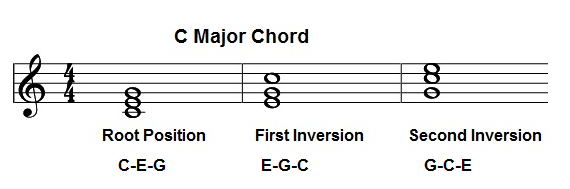
The image above shows and example of an inversion - Piano-Keyboard-Guide.com
The word inversion has a distinct, but related meaning when applied to intervals, chords, voices and melodies. An interval is inverted by raising or lowering either of the notes by one or more octaves so that the positions of the notes (within a chord) reverse, meaning the higher note becomes the lower note or the lower note becomes higher.
For an example, the image above shows the chord C Major. The root note is C so C was taken down an octave changing the position of the note but not changing the chord.

No comments:
Post a Comment