Speakers:
Line Array Speakers:
The Line Array speakers are a loud speaker system. Line array speakers are made up of many identical out loud speakers to create a near line source of sound. These speakers are mainly seen in concerts at the top of the stage up high so the sound can reach the far back of the audience, this is mainly why the speakers face different vertical angles to cover a greater depth of field.
The image of the speaker is shown below.
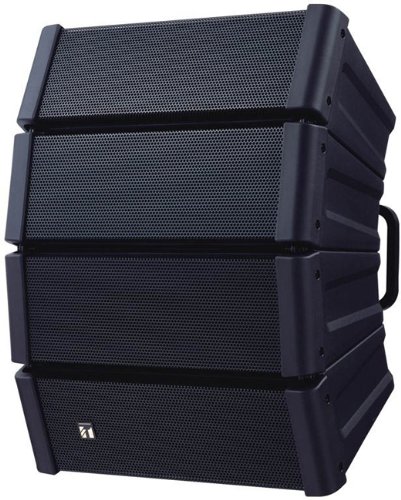
 https://goo.gl/images/1DVBPw
The passive speaker only has a port for the speak on cable meaning, it needs to be supplied with a separate power amplifier. Advantage of a passive speaker is you don't need a lot of wires connected to it. Disadvantage you have to connect a power amplifier to the speaker
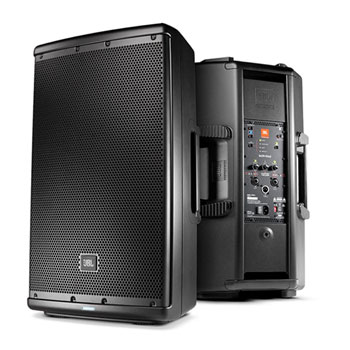 https://goo.gl/images/rWi8ni
The active speaker has the amplifier inside of it, as you can see in the image the amplifier is found on the back of the speaker. The active speaker seems to make more noise than the passive speaker.
A mixer is very important, it makes the performances. A mixer has different channels and these channels allow more devices to be connected and routed through it. Channels are designed to accept microphones and devices such as amplifiers, preamps, or signal processors.
An amplifier is an electronic device which is used in sound reproduction and is used for increasing the amplitude of electrical signals.
A preamplifier converts a weak electrical signal to a strong signal what is noise-tolerant and is strong enough for further processing.
A Digital signal processor can process data in real time making it easier for applications that can't tolerate delays.
- Analogue mixer
 https://goo.gl/images/bHm9Hz
-Digital mixer.
Different Mixers
- Analogue mixer
https://goo.gl/images/bHm9Hz-Digital mixer.
 https://goo.gl/images/HzyLph
The difference between a Analogue and a Digital mixer is,
an analogue mixer has a lot of outboard gear, this means it is heavy and hard to move around. Whereas all racks are inside of the digital mixer meaning this is easier to move if needed because you only need to move the mixer and not any outboard gear.
A power amp is used to power loud speakers. the image of a power amp is shown. below.
A power amp is only needed for an analogue mixer, this is because everything inside the digital mixer is inside.

https://goo.gl/images/Bheq3p
Video assessment:
https://youtu.be/vgMKO9VwCbw
This link leads to YouTube, it shows me connecting the mixer to the power amp and then to the passive speaker. Within this video I also set up a microphone (the Shure SM58).
Within this video I am explaining what I am doing in steps. I was watching my performance and how I was explaining the steps I could see that I was nervous and that I was also questioning myself. This video would have been better if I made myself seem more confident. was watching a video of Dele demonstrating the set up, this is what helped me remember the steps.
Microphones:
Dynamic:
-A dynamic microphone is usually found on stage
-Very durable - it is built to last long
-Capable of receiving high SPL ( sound pressure levels).
Condenser:
-A condenser mic is usually found in the studio, or used to mic up a drum kit
-Very sensitive - picks up everything (sound)
-A condenser mic has a large diaphragm if used for a vocalist to pick up the voice whereas the small diaphragm would be used for something more specific, for example symbols on a drum kit.
This link leads to a website explaining how a dynamic microphone is built.
Dynamic vs Condenser Microphone - Operating Principle | Knowledge ...https://www.shure.com/.../find.../dynamic-vs-condenser-microphone-operating-principle
Dynamic microphones employ a diaphragm/ voice coil/magnet assembly which forms a miniature sound driven electrical generator. Sound waves strike a thin plastic membrane (diaphragm) which vibrates in response. A small coil of wire (voice coil) is attached to the rear of the diaphragm and vibrates with it. The voice coil itself is surrounded by a magnetic field created by a small permanent magnet. It is the motion of the voice coil in this magnetic field which generates the electrical signal corresponding to the sound picked up by a dynamic microphone.
The paragraph above was picked out from the website explaining the build of the microphone and how it works.
I also found an image on this website:
 Dynamic vs Condenser Microphone - Operating Principle | Knowledge ...https://www.shure.com/.../find.../dynamic-vs-condenser-microphone-operating-principle
The image above shows the build of the dynamic microphone.
On the same website it spoke about condenser microphones, I selected a paragraph what further explains a condenser mic and how it works.
Condenser microphones are based on an electrically-charged diaphragm/backplate assembly which forms a sound-sensitive capacitor. Here, sound waves vibrate a very thin metal or metal-coated-plastic diaphragm. The diaphragm is mounted just in front of a rigid metal or metal-coated-ceramic backplate. In electrical terms this assembly or element is known as a capacitor (historically called a “condenser”), which has the ability to store a charge or voltage. When the element is charged, an electric field is created between the diaphragm and the backplate, proportional to the spacing between them. It is the variation of this spacing, due to the motion of the diaphragm relative to the backplate, that produces the electrical signal corresponding to the sound picked up by a condenser microphone.

Dynamic vs Condenser Microphone - Operating Principle | Knowledge ...https://www.shure.com/.../find.../dynamic-vs-condenser-microphone-operating-principle
This image above shows the build of the condenser microphone.
The difference between a dynamic mic and a condenser mic is the transducer inside the microphones. The transducer is how the microphone picks up sound and transforms it into electrical signals.

No comments:
Post a Comment